
The Discretionary Edge Over Algorithms
Can a human win against billion dollar algorithms? Yes.

At the time of writing this, I have been watching the [crypto] markets for several years now, along with one year of full-time study and work on algorithmic trading. I have created live trading bots and tested many automated strategies, some with success. Yet today, I am actually happy trading manually and profitably. Some might be surprised to hear this. Why?
The Doomer Phase
Virtually any trader that’s been able to be overall profitable for at least a year would have had a phase of immense pessimism and defeat as part of their journey. They would have heard 90% of traders fail. Going a little deeper, they would have also heard 70% of trading volume is algorithmic. And eventually, they’ll hear these algorithms are developed by large teams of high-IQ, poly-PHD quants perfectly coordinated to be exploiting every edge possible. All that is true, and by now you have recognised your mortality as an individual, discouraged.
Algorithmic Methods
Often the two big appeals of algorithms to a budding retail trader are either:
The promise of passive income
Taking the emotion/decisions out of trading
Anyone that has tried and tested writing algorithmic trading strategies knows this is no easy task. Those which are naïve may think they’ve found success via beginner’s luck and solved the markets, but I guarantee they had not back-tested over a long enough period of time. Unfortunately, this hyped motivates fresh blood to deploy live too soon and eventually blow it all.
But let’s overview ways algorithms can be curated:
Technical analysis and indicators - the most common method
Order book analysis - typically done by quants doing high-frequency trading (HFT)
Market sentiments - generally this type of infrastructure belongs to the institutions (BlackRock’s Aladdin, Bloomberg Terminal)
Exclusive & extraneous data
How the Institutions Win
The big bad institutions win because they cheat, they have an unfair advantage.
They have a monopoly on HFT. They bribe millions to physically have nearby access to the infrastructure of exchanges so they can peak and act on the order book before the masses see price respond.
If you use a basic indicator like a the RSI on a lower timeframe, buy when it’s oversold and sell when it’s overbought, 9 times out of 10 the candles will be green leading up to overbought, price may make it to that zone but gets sold off before the candle confirms, resulting an a big red candle that closes almost exactly at your entry. This is because you’re not at the front of the line, but they are.
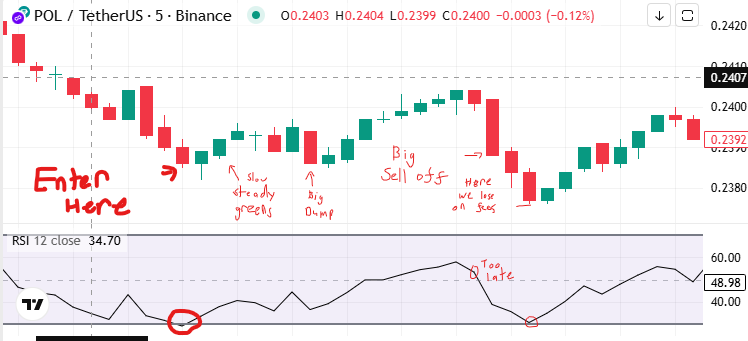
Stop-loss market orders shouldn’t be on the order book showing as liquidity, but often they have special access to this information which aids them in triggering liquidity sweeps.
So, it may seem like institutions could win almost every time. But maybe you know an uncle you trust and he’s profitable. How does he do it? The truth is, the institutions have to share some of their wins with retail traders.
Institutions can provide a LOT of liquidity into the markets but to actually turn a profit, they need retails traders to also put in, too. And for that to happen, there needs to be HOPE. No one is going to play a game they know is rigged against them. While the game of trading is very rigged, it’s not impossible to find an edge.
Being an institution that can move the market to their will isn’t always as easy as it sounds. The psychology is different. To manage money for an institution is a heavy task, and their strategy is often VERY risk adverse. Because they conform to certain ways, it is possible to find their kryptonite and scalp a few grains from their bowl.
Technical Analysis
I value technical analysis. Is it magical? Mostly no, but somethings I have discovered to be profound. Just above, I gave an example on how the RSI often falls victim to big selloffs prior to the classic escape condition, and likely stopping you out at a loss. So you’re already aware you’re probably not going to be able to take profits fast enough in a robust, repeatable manner. I’m going to break down technical analysis into two categories:
Indicators
First, let me say price is truth. 90% of standard indicators are just based on price, with another handful being derived from price and volume. For the most part, indicators are NOT magic. Very rarely will they tell you something you cannot already find by looking at candlesticks. Trading discretionarily. they really just aid with added convenience and confluence.
But they’re very attractive for algorithmic trading because from code, you can’t really just look at a chart. Indicators give simple numbers that are easy to evaluate conditions like “Is the price above the moving average?” or “buy when the RSI is below 30.“Subjective Mark-up
By mark-up, I mean drawing trendlines, support, and resistance. Like like how you learnt to draw the “line of best fit” in high school, I believe this is best done by the fuzzy judgement of the human eye. Computers struggle with this, and I explain in an example below.
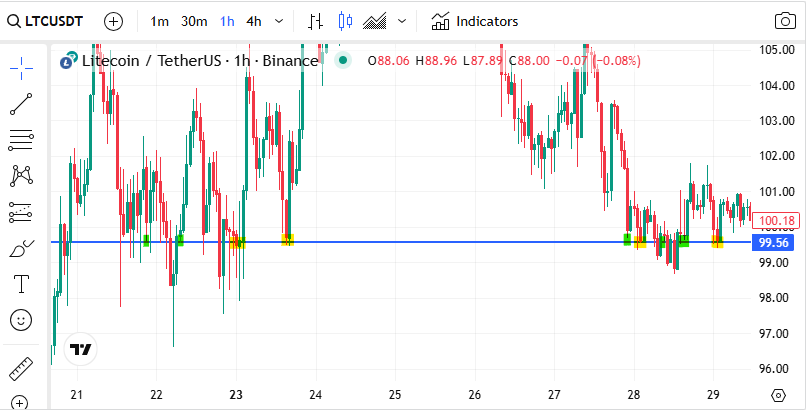
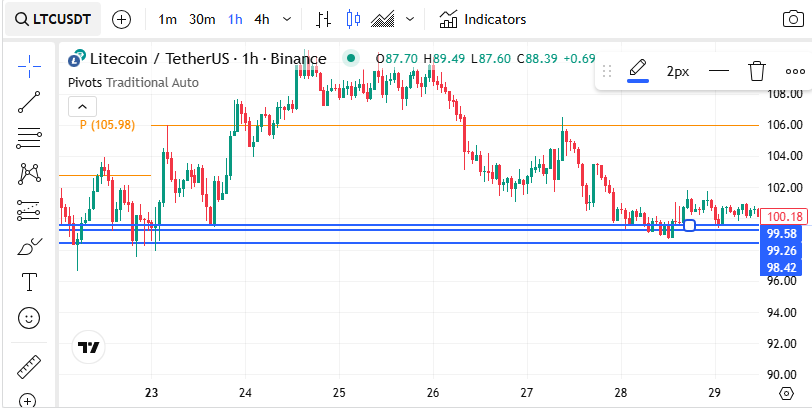
Above is a support line I drew via intuition. While subjective, I feel like most people would agree I did a good job. I generally believe candles bodies (highlighted yellow) hold more substance than candle wicks (highlighted green). Yet in the above example, I show 4 body contacts and 3 wick contacts. Now in the below example, I’m wondering how I would draw it if I only allowed body contacts in my criterion.
And if I were to choose wicks only:
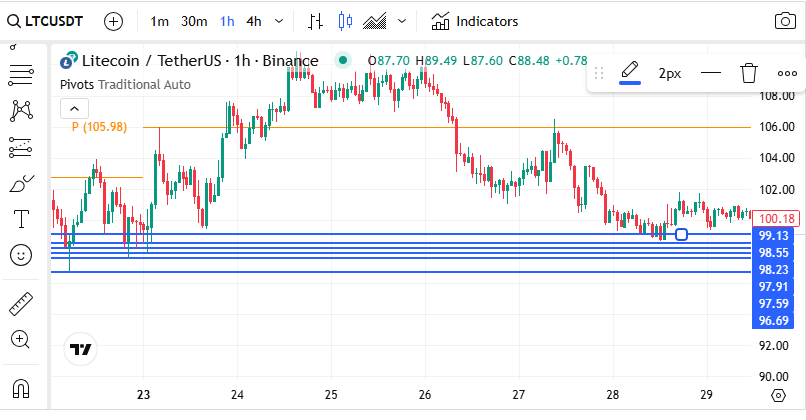
Regardless of my lookback period, I am by far more confused. Of course, it’s not impossible to code support/resistance detection for algorithms, but the quality will vary and you can expect false and missed signals, even with AI and computer vision.
From journaling my own trades, I can tell you that trendlines, support, and resistance hold the most weight (I can think of more, but I won’t share my entire hand today). Indicators without the use of discretionary mark-up struggle to hold weight. I would argue indicators are myopic and lack reference to the wider story. If a picture is worth a thousand words, a chart is worth a thousand indicators.
Other Discretionary Edges
Aside from drawing lines on charts, other benefits of trading as a human are:
Being aware of the news and sentiment
Being aware of manipulations
Having a gut instinct
Being dynamic
Greater risk management flexibility
Better understanding of charts
Having familiarity and an intimate understanding of a specific asset.
Conclusion
To wrap up, there is still hope for retail traders, even if we live in the age of data, manipulation, crazy mathematics and AI. Do drop your thought below.